Top 10 Book Series of the Past 50 Years That Shaped Modern Reading
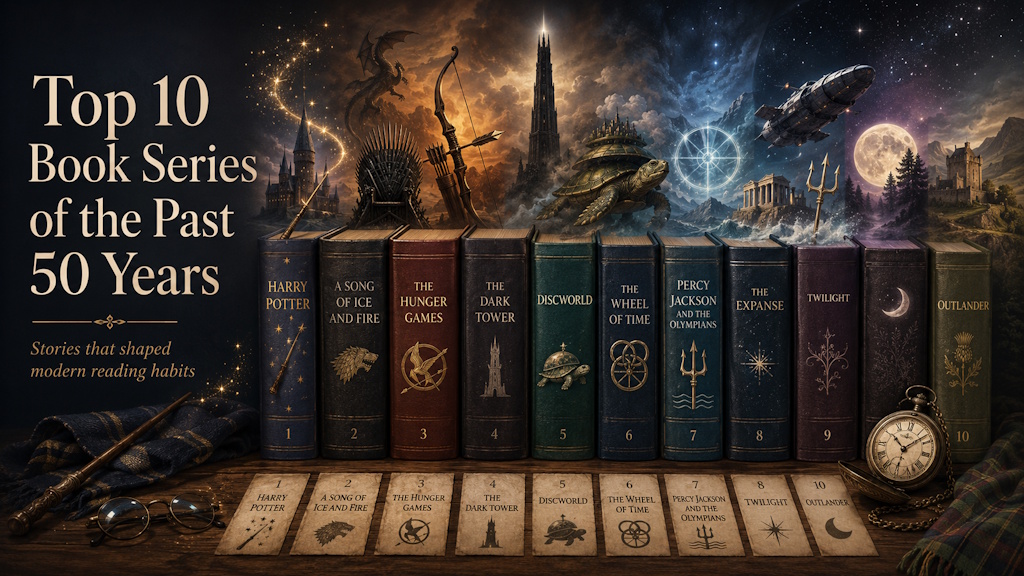
Looking back over the last fifty years, book series have shaped reading habits in a big way. A strong series pulls people in, keeps them invested across multiple volumes, and often grows far beyond the page. Some became long running companions for readers, others sparked films, shows, and endless conversation. Below are ten series from the past five decades that stand out for their reach, staying power, and the way readers kept coming back for the next book.
The Harry Potter series by J.K. Rowling changed modern publishing almost overnight. Starting in the late 1990s, the seven-book run followed a young wizard growing up while facing darker and more complex challenges with each installment. The books balanced school life, friendship, and high stakes conflict in a way that appealed to kids and adults alike. Sales numbers reached levels rarely seen in publishing, and the series helped bring an entire generation back into bookstores.
George R.R. Martin’s A Song of Ice and Fire took fantasy in a different direction. The books are dense, political, and often unforgiving to characters readers grow attached to. Spanning five published novels so far, the series focuses on power, loyalty, and survival across multiple families and regions. Its layered storytelling and refusal to offer easy resolutions earned a devoted audience long before the television adaptation brought it to a wider crowd.
Suzanne Collins found massive success with The Hunger Games, a trilogy that blended action with sharp social commentary. Set in a future society built on inequality and control, the books follow Katniss Everdeen as she navigates a brutal system designed for entertainment and fear. The pacing is tight, the themes are clear, and the emotional weight carries through all three novels, making the series one of the defining young adult works of the 2000s.
Stephen King’s The Dark Tower stands apart from almost anything else he has written. Spanning eight main books, the series blends fantasy, westerns, horror, and science fiction into one long narrative centered on Roland Deschain and his pursuit of the Dark Tower. King wrote these books across decades, allowing the series to evolve in tone and scope. For longtime readers, it acts as a connective thread tying much of his larger body of work together.
Terry Pratchett’s Discworld proves that a series can be both funny and thoughtful at the same time. With more than forty books published between the 1980s and 2010s, Discworld is set on a flat world carried by elephants standing on a giant turtle. Beneath the humor, Pratchett tackled politics, religion, policing, and human behavior with surprising insight. Readers could jump in almost anywhere, yet still feel part of a larger whole.
Robert Jordan’s The Wheel of Time is known for its sheer scale. Beginning in 1990 and concluding in 2013, the fourteen book series follows a large cast of characters in a richly detailed world built around prophecy, power, and balance. The commitment required from readers is significant, but those who stick with it often point to the depth of the world building and long term character arcs as the payoff.
Rick Riordan introduced a new generation to mythology through Percy Jackson and the Olympians. The five book series centers on a modern teenager who learns he is connected to the gods of Greek myth. The tone is fast, humorous, and accessible, which made it especially popular with middle grade readers. Beyond entertainment, the books sparked renewed interest in classic myths through a contemporary lens.
James S.A. Corey’s The Expanse brought hard science fiction back into the mainstream. The nine book series explores humanity’s expansion into the solar system, mixing political tension with personal stakes and realistic technology. The characters age and change across the books, giving the story a grounded feel despite its large scope. It gained steady momentum through word of mouth before expanding into television.
Stephenie Meyer’s Twilight became a cultural phenomenon in the mid 2000s. The four book series follows a teenage romance tied to vampires and werewolves, blending supernatural elements with emotional drama. While often debated and criticized, its impact on young adult publishing is hard to ignore. It opened doors for many similar series and brought countless new readers into bookstores.
Finally, Diana Gabaldon’s Outlander blends historical fiction, romance, and time travel across a long-running series that began in the early 1990s. With nine major novels and more planned, the books follow Claire Randall as she moves between centuries and navigates love, war, and survival. The attention to historical detail, combined with strong character relationships, has kept readers invested for decades.
Taken together, these series show how powerful long-form storytelling can be. Each found a way to hold attention across multiple books, build loyal readerships, and leave a lasting mark on modern reading habits.